
European infrastructure is accelerating. Ductile iron is not a secondary component.
Europe continues to invest heavily in infrastructure.
In 2024, the European Investment Bank mobilised over €100 billion for new and upgraded infrastructure projects, while the EIB Group aims to reach €1 trillion in climate and sustainability investment by 2030. In parallel, the EU’s TEN-T policy is driving the development of transport networks across land, sea and air, with a 2030 horizon, supported by the Connecting Europe Facility, which will allocate more than €25 billion to sustainable transport systems between 2021 and 2027.
At a local level, the trend is equally clear: local public investment accounted for two-thirds of total public investment growth in the EU in 2023, and 56% of European municipalities plan to significantly increase spending on climate change mitigation.
All this infrastructure requires components. Many of them are made of ductile iron.
Why ductile iron in civil works?
Ductile iron is the reference material in Europe for a wide range of infrastructure components. The European standard DIN EN 1563 defines the grades and mechanical properties of spheroidal graphite iron, and its use is widespread in pipeline systems and construction applications.
This is not arbitrary. The spheroidal graphite structure provides mechanical properties that few materials can match in environments subject to high loads and long service life requirements.
Ductile iron offers high tensile strength, superior ductility and excellent impact resistance, making it particularly suitable for components that must withstand dynamic loads — such as heavy traffic, vibration or thermal expansion — over long periods with limited maintenance.
Key applications in growth
In urban drainage, ductile iron dominates the market for manhole covers and gully gratings. The European standard UNE-EN 124-2 is the most widely adopted framework globally for access covers and surface drainage systems, influencing infrastructure projects across Europe. It classifies products into six load classes, from pedestrian areas (A15) to airports and heavy-duty industrial zones (F900).
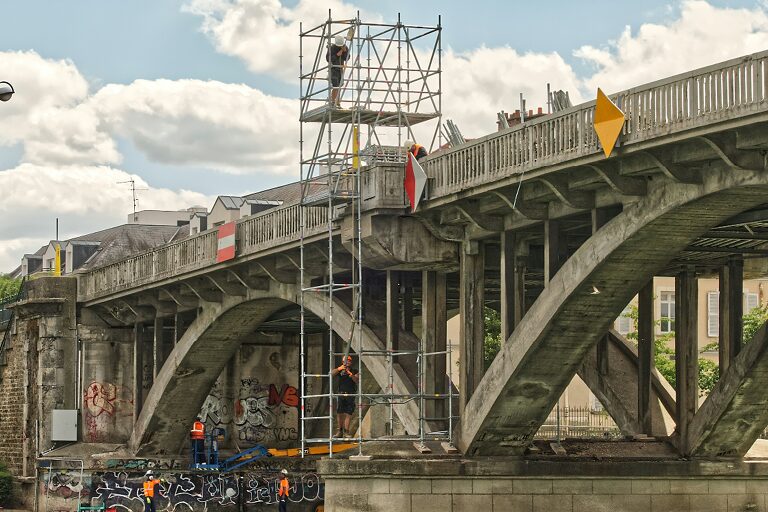
In bridges and walkways, structural bearings, expansion joints, anchoring elements and integrated deck drainage components are commonly manufactured in ductile iron due to their ability to accommodate variable loads without permanent deformation.
In railway infrastructure, track components, pulleys, catenary elements, fastening systems and inspection chambers also rely on ductile iron, often subject to specific approval requirements from operators — such as those defined by Deutsche Bahn in Germany.
What does the market require?
The European regulatory environment has changed the nature of public procurement. Compliance with technical standards alone is no longer sufficient. Public tenders — particularly in Northern Europe — increasingly include environmental criteria requiring verified documentation of the environmental impact of the materials used.
This is where FDES (Environmental and Health Product Declarations) comes into play. FDES is a Type III environmental declaration in accordance with ISO 14025, providing Life Cycle Assessment (LCA) results along with health-related data. It is used to calculate the overall environmental performance of buildings and infrastructure.
With the implementation of RE2020 in France, the use of FDES has become mandatory. In its absence, default penalising values are applied. In procurement processes, some project owners already require suppliers to provide FDES documentation for installed products, and this requirement is expected to become standard practice in new-build projects.
Material traceability — from raw material origin to chemical composition and process control — is another requirement increasingly demanded by major contractors and infrastructure operators.
The role of foundries
Iron foundries, as key suppliers of components integrated into civil infrastructure, play a fundamental role. This role increasingly involves reducing environmental impact and operating responsibly within the broader industrial ecosystem.
In our case, FUNOSA is a grey and ductile iron foundry based in Barcelona, with in-house engineering and quality departments, supplying a range of European industrial sectors. In civil works, we hold IO-CERT, AFNOR (NF) and FDES certifications.
The latter enables us to quantify and communicate the environmental impact of our components throughout their lifecycle, facilitating their integration into projects with documented environmental requirements.